Sunday, February 28, 2021

Sepia Saturday 559 - NUMBERS 1

 Numbers at last!!  I love numbers and in my family history there seem to be so many interesting ones, so let's see what I can do with NUMBER 4.

My husband Don was one of 6 boys, but at one stage there were only 4 of them. This photo always amuses me. They were obviously told to stand up straight, fold their arms and smile at the camera. The two in the middle are twins - more about them next week.


And here we have the four younger ones.  The twins are the bigger ones this time. You'll have to wait until Number 6 to see the whole lot together.


The four older ones again all dressed up in their Sunday best and off to the zoo.


Here we have 4 generations of Don's family. Great Grandmother, Grandmother, Mother and his eldest brother Fred - the first grandchild.


Not to forget my side of the family. My three great Aunts Agnes, Ida and Laura again with the first grandchild. This was taken sometime in 1894. The baby, Ernst, was born in February of that year.

I have published this one before, but I love it. The four oldest children in my mother's family of 9 children. My mother is on the right. This must have been taken around 1910. The cottage was built for my great grandparents on their marriage in the 1860s and stayed in the family until 2000 when my mother sold it to move into a nursing home. I lived there in the fifties as a teenager.


Four Likely Lads looking for a bit of fun.  My husband (on right), his brother and two friends - taken, I think at someone's 21st around 1957


Me with three of my Teachers College mates, hamming it up for the camera. I think I must have fancied myself as a bit of a blonde bombshell judging by the pose.


Here am I with my three beautiful bridesmaids Lia, Kate and Chris.


A not very good shot of Don and I with our two daughters - when we were still four in the family.


Finally, because this must be getting a bit boring, Four generations of my family - great grandmother (my lovely mother Laura), myself, my youngest daughter, Mandy and out first grandchild, the adorable Niamh. My mother was 96 in this shot.


Liz Needle  -  linking with Sepia Saturday.


Sunday, February 21, 2021

Sepia Saturday 558

 Back on board again.  Sepia Saturday this week is all about the end of the alphabetic series

Next come numbers which will be a change and one I hope to be able to use some of my old family photos for. Meanwhile I think I will go for a topic on zoos and see what I can dredge up. We didn't have a camera when I was a small child, so my photos may be few and far between.

I remember frequent visits to the Adelaide Zoo with my parents and also to the Koala Farm which was situated close by. In those days the zoo was very old-fashioned with small barred cages  and unattractive areas for the animals. It is very different now. In fact I was unable to find any old photos of the zoo and its inhabitants on the internet. Strange!

This photo of me, taken when I was about 10 was taken at the old Koala Farm - a favourite place for birthday parties as there was a giant slippery dip, camel rides, koala cuddles, a snake pit, diving seals and a lot more.


This photo shows actor Noel Coward with a young koala.

This is the camel wagon taking visitors for a ride around the park


The Adelaide Zoo was a much larger area with a great number of different animal species. It's current claim to fame is a pair of pandas - the only ones in the southern hemisphere and a great drawcard. Back when I was small the favourite attraction was "Samorn", an asian elephant who for many years carried children on her back initially and then in her later years in a wagon that she pulled around the zoo. Nowadays it would be regarded as cruelty to animals, but 70 years ago Samorn was adored by thousands of kids and we never thought about it as cruel. 


Other favourites were George the Orangutan,  Percy the Chimpanzee and the beautiful Greater the Flamingo.


A rare family photo of the Needle clan getting ready to go into the zoo. This must have been taken in 1967 while we were waiting outside for a few more family members to arrive.
Quite amazing to see how the ladies dressed  up to go to the zoo in those days.


And finally, my three kids enjoying a rare trip to the zoo in 1971. We had just come down from Darwin where they were all born, so a trip to the zoo was very much an occasion then.


Liz Needle  -  linking with Sepia Saturday.


Saturday, May 30, 2020

Sepia Saturday 522


I was really pleased to see the theme this week - one close to my heart. Gardening is in my blood and in the blood of my ancestors.  My great grandfather, a German botanist, came to Australia in 1851 and worked at the Melbourne Botanic Gardens as head plantsman and secretary to Ferdinand von Mueller, the Director of the gardens. E.B. Heyne drew up the plans for the Botanic Gardens.


He moved to Adelaide around 1860 and established a nursery and opened the first shop for seeds and plants in South  Australia. He wrote regular articles for the 'South Australian Register' about the cultivation of forest trees, forage plants and pasture grasses.

In 1871 he published "The Fruit, Flower and Vegetable Garden" a book which ran into four editions and was the first of its kind in South Australia. He was a prolific writer and secretary to the Vignerons Club where his contribution to the wine industry was publicly acknowledged.


His son, Carl, graduated from Roseworthy Agricultural College, then took over the management of the shop and nursery. He had nine children. Below are the four oldest in front of the original nursery. at William Street Norwood. My mother moved back to live in this house in 1956. The house is still there, but no longer in the family as my mother had to sell it when she moved into a nursing home.


Site of the nursery around 1911. My mother is on the left.

The family moved the nursery to Summertown in the Adelaide Hills, but later re- located to Beulah Park where the nursery is still situated, run by the fifth generation of the Heyne family.


Part of the nursery in the thirties at Beulah Park

My grandfather Carl and his van

My grandfather Carl (CF Heyne) and his son FW (Wally) Heyne

Wally and his wife Vera took over the nursery after the death of Carl in 1948 and the business passed on to his two younger sons, Roger and Gary and to their sons currently.

Heyne's Garden Centre and Wholesale nursery are flourishing under the fifth generation. Check out the link here.


Liz Needle  -  linking with "Sepia Saturday".


Sunday, May 24, 2020

Off With the Birds - Wattlebirds


This week's bird or birds are larger Honeyeaters, known as Wattlebirds. We have four wattlebirds in Australia, but only two here in South Australia. We are lucky enough to have them visit our garden on a regular basis. They are the largest of the honeyeaters and very aggressive towards the smaller varieties around food sources. 

Both species are nectar and insect eaters, inhabiting heathlands, shrubby forests, eucalypt forests, parks and gardens. Both are noisy with a variety of harsh calls. One of the Wattlebirds in our garden sounds like he is saying "woodpecker, woodpecker, wood", though my husband tells me I am imagining this.

Little Wattlebird - Anthochaera chrysoptera - is the one we see more of and is more aggressive and less shy than the other species we get. It has a dark brownish grey body streaked white and without 'wattles'. It does have a faint silvery cheek patch, pale blue-grey eyes and white tipped tail and wing feathers. Females are smaller, but similar.

Last year we watched in delight as a pair of lovers serenaded and danced on our balcony fence rail for several days.


Immature bird is paler and less streaked than the mature ones above.


The Red Wattlebird - Anthochaera caranculata is the largest mainland honeyeater.  It has large distinctive red wattles that lengthen and darken with age. It has a black head, silvery white face and yellow centre belly. They seem to be a lot shyer than the Little Wattlebird and we only see them very occasionally in the garden. The Red Wattlebird is common but nomadic, following the nectar flowers.


The only time I have ever seen a Red Wattlebird at the birdbath. He must have been very thirsty because he stayed a while.


Saturday, May 23, 2020

Sepia Saturday 521


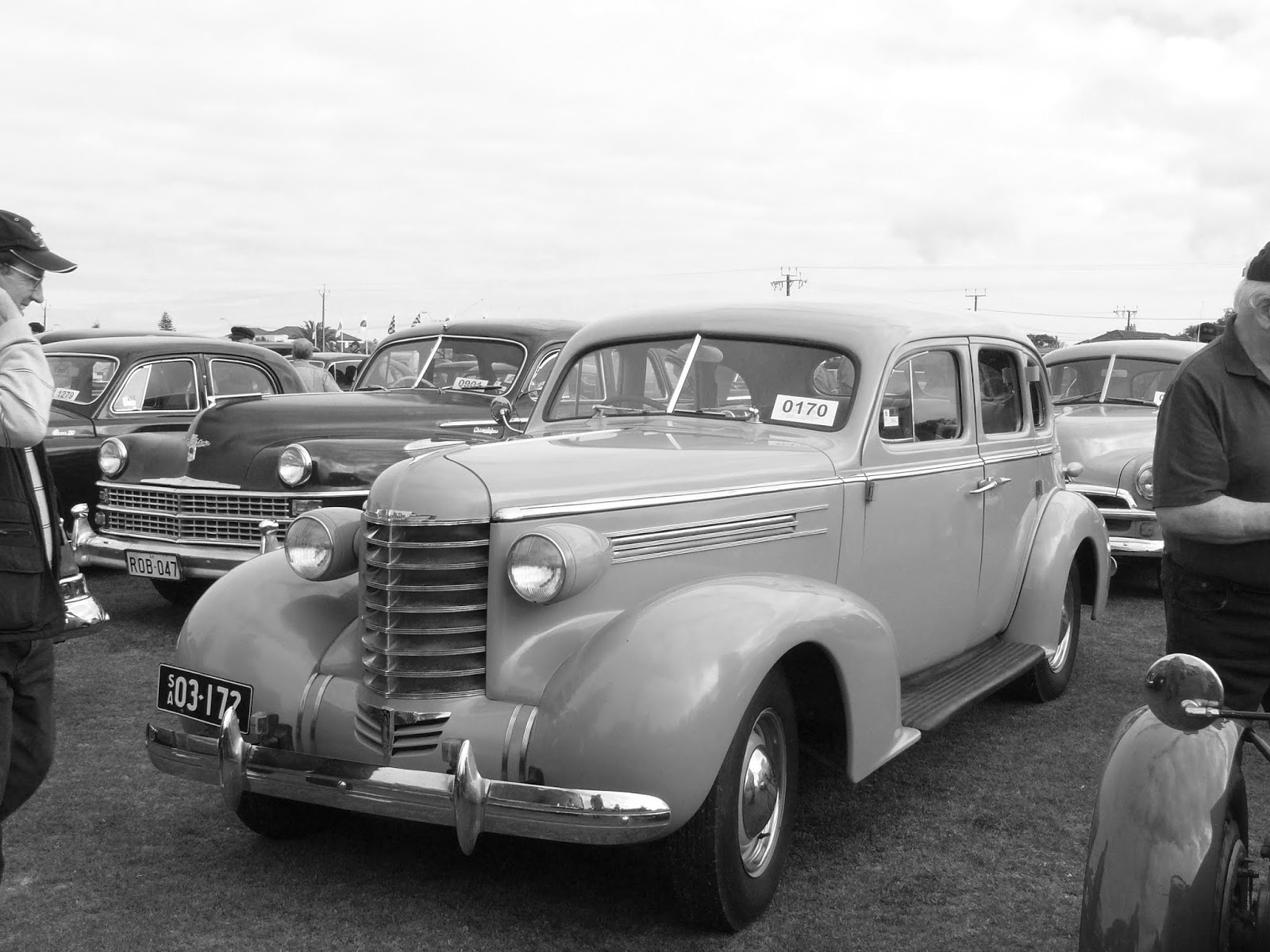
Sepia Saturday this week is about cars and trophies and wherever else this picture takes you. For me it's cars - vintage and veteran cars. I love them.

Close to where we live is the Australian National Motor Museum and I have spent many hours wandering around admiring the myriad of beautiful vehicles. Each year they organise a Bay to Birdwood run when vintage and veteran cars from all over this state and others drive from Glenelg, a beachside suburb of Adelaide up into the Adelaide Hills to Birdwood, home of the museum some 40 plus kilometres away, up steep and winding roads. Some of the vehicles stall along the way, but a surprising number make it.

Several years ago Don and I made the journey in a thirties Oldsmobile owned by our daughter's partner. We felt very grand driving in this gracious old lady and waving regally to the many spectators along the way. Here is a selection of the cars that took part - converted to black and white in keeping with the Sepia Saturday theme.

The Oldsmobile we travelled in.

Model T Ford
Not sure what, but American I think
Had to put this one in colour - always dreamed of owning one.

Silver Jaguar - would have given an arm and a leg for this.

A Humber - my Dad drove one of these, but not this model

Austin 7


Morris Minor - remember these as a teenager. Often the first car we could afford in those days.


I could keep going, but would hate to bore you.  I hope you enjoyed mr selection of golden oldies.

Liz Needle  -  linking with "Sepia Saturday".


PS. I've added this one in colour because one of my readers wanted it in sunshine yellow. This is the actual colour.


Sunday, May 17, 2020

Off With The Birds - New Holland Honeyeater


My bird for today is one of the very common ones that lives in my garden  -  New Holland Honeyeater (Phylidonyris novaehollandiae).

These little fellows are very active, unafraid, aggressive towards other honeyeaters and very common in gardens and park.  I am get a lot of pleasure watching their antics in the garden and in flight.

The sexes are alike - mostly black and white streaked, with a bright yellow wing patch and white ringed eyes. They are mainly reliant on nectar, but do eat insects which they catch in mid-air  and are very protective of their feeding grounds. In our garden they like the Banksias, Grevilleas, Salvias and Agapanthus. They have a loud metallic high pitched call and other contact and alarm calls.


                                                      Drying in the sun.


                                                             Best of Friends


Liz Needle  -  linking with "Saturday Critters", "Our World Tuesday", "Wild Bird Wednesday" and "I'd Rather B Birding".